.png) 2 months ago
63
2 months ago
63
Your heart almost stops the moment you enter Saodat Ismailova’s As We Fade. Within a minute, you’ll forget about the outside world. The Baltic has curated a concise, brave first solo exhibition in the UK of film pieces by the Uzbek artist and film-maker. It is exhilarating, terrifying and unforgettable.
The room is dark. Four works are arranged around a padded black square in the centre for sitting or lying down on – a reference to the void, something Ismailova has been fascinated with throughout her two-decade practice. She grew up during perestroika, a period of widespread political, social and economic reform in the late 1980s, when Soviet ideology began to collapse leaving a void in the culture. Ismailova felt this deeply – her father was a cinematographer and she was on sets with him from a young age. The family lived in a building opposite the largest and oldest film studio in Uzbekistan. During perestroika, films stopped being screened in public.
The four works sing to each other across the void; they crackle, scream and collide. The atmosphere of the space is elemental – images of fire, ice and cascading currents of water recur across the projections, while you can almost feel the sand whipping the back of your neck as you listen to the powerful desert wind.
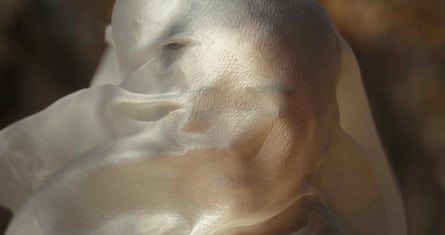
The first work that draws me towards it is the mesmerising, eponymous As We Fade, projected through 24 sheaths of silk suspended in the air, arranged in a glittering, shimmering line. The silk is significant, since the artist’s homeland, Uzbekistan, sat at the heart of the ancient trade route between east and west. The number of silks mimics the old cinematic standard number of frames projected per second. The footage, found and new, is of people performing rituals on the sacred Sulaiman Too mountain. It can’t be seen on every panel – they fade and disappear. Ismailova wants us to think about the images, but also what is not seen.
References to the subconscious abound – the whole space feels like a psychic dreamspace. The strange, mystical Melted Into the Sun plays at the bottom of the space, with traditional cushions (that once belonged to the artist’s grandmother) on the floor. The film loosely and lyrically explores an 8th-century prophet-like figure, Al-Muqanna. Faceless figures pace through the dusky topographies and under magenta skies, between significant locations: the Amu Darya river, the burial ground of Chillpiq; the city of Bukhara. With aspects of ASMR and video game aesthetics, the film avoids getting too bogged down in its retelling of local history. And its questions, asked by a narrated voiceover in the uvular sounds of Uzbek, are universal: who determines where is east and where is west?
I was blown away by Swan Lake, a rapturous ode to films from the central Asian region made between 1988 and 2001, from the collapse of the eastern bloc to the post-Soviet period. Ismailova’s film is visceral, poetic, avant garde but intelligible, deeply rooted in a time and place yet without boundaries. It captures the ambience of the time with an orchestral command of the exquisite cinematography taken from 28 films made in Kazakhstan, Uzbekistan and Tajikistan.
There is scene after scene of breathtaking beauty, violence, protest, disorientation and anxiety; men, women and children dreaming; a woman kissing a fish; a man licking a shard of glass and a woman bursting into flames. There is crackling footage of ballet dancers performing Swan Lake, which was broadcast on state TV on a continuous loop following the deaths of Leonid Brezhnev, Yuri Andropov and Konstantin Chernenko in the 1980s, and later when the Soviet Union collapsed.
after newsletter promotion
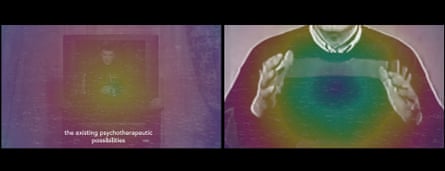
The work is threaded through with ideas about psychic space, power and propaganda. You allow yourself to be pulled along even as it warns that you are being manipulated. It was inspired by Ismailova’s memories of watching the hypnotist Kashpirovsky, a Rasputin-like figure, on Soviet state television. In 1989, he attempted mass hypnosis – an excerpt of the broadcast is included – in the USSR’s last effort to save its crumbling regime and control its population.
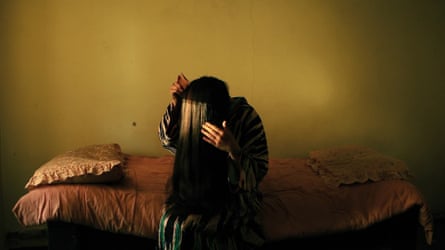
Ismailova is known for making works that consider the distinct male and female realms in central Asia, and this show riffs on these parallel worlds – centred on Zukhra, which was shown at the 2013 Venice biennale. It is a single, long shot of a woman sleeping on a bed, soundtracked with archival news recordings and a narration of the legend of Venus. Then she gets up and walks out of the room, leaving us looking at the empty bed. It is a daringly simple work that perfectly evokes the enormity and possibility of a woman’s apparently passive and domestic inner world – the space in which she is often confined to but not diminished by.
You could be subsumed in this world for hours. Each film here is a universe of its own, richly layered, steeped in historical allusions. Yet clear meanings and political context matter less than magic and feeling in As We Fade. It is a show about how we hold on to the past and how to let go – and leaves you staring into the darkness, wondering what might emerge.