.png) 2 months ago
69
2 months ago
69
Lib Dems urge Starmer to let Labour MPs vote for their 10-minute rule bill saying UK should join customs union with EU
Today the Lib Dem MP Al Pinkerton will use the 10-minute rule procedure in the Commons to propose a bill for the UK to join a customs union with the EU. S0-called “10-minute rule bills” never get properly debated, and never become law, but they allow an MP to make a speech in Commons “prime time” defending a particular cause. Normally there is no division when the speaker asks MPs to agree “that leave be given to bring in the bill”, but sometimes MPs object and force a vote.
Ed Davey, the Lib Dem leader, has written to Keir Starmer urging him to allow Labour MPs to vote for the bill if there is a division. Presumably the Lib Dems are hoping that Tory MPs do object, because then a division will take place and votes are recorded. For campaigning purposes, it would be helpful to Lib Dem candidates to be able to say, when given the chance to vote for joining a customs unions, certain Labour MPs did not vote, or voted against.
In his letter to Stamer, Davey said:
Even if the government retains its position of ruling out a customs union - despite the significant boost to economic growth which it would deliver - it is only right that you grant your backbenchers the opportunity to express their support for it.
The government normally tells its MPs to abstain in votes on 10-minute rule bills, on the grounds that they have no practical impact, but in October it abandoned this position to allow backbenchers vote down a Nigel Farage 10-minute rule bill calling for withdrawal from the European convention on human rights.
Key events Show key events only Please turn on JavaScript to use this feature
Badenoch is now taking questions.
Q: Will you be consulting Iain Duncan Smith about this?
Badenoch says Duncan Smith is the father of welfare reform.
But the problems he was work and pensions secretary (he created universal credit) are different from the problems now.
Badenoch suggests there are too many loopholes in household benefit cap
Badenoch says the Tories will review the way the household benefit cap operates.
This is a policy introduced by George Osborne when he was chancellor. It imposes a cap on the total amount a household can receive in benefits.
She complains there are too many loopholes.
Badenoch says Tories will review welfare as part of campaign to 'get Britain working again'
Badenoch says the Tories want to get people who are out of work back into the labour force.
Some of the party’s proposals were already announced at the party conference, she says.
But today the party is launching a campaign to “get Britain working again”. She says this will involve a review of the way the welfare state works.
Badenoch claims last year saw the biggest increase ever in the number of workless households.
She says the UK now has more people living in households where no one works than the entire population of Estonia.
Badenoch goes on to criticise the plan to get rid of the two-child benefit cap on the grounds that some families with a large number of children will benefit.
She says in Hackney alone there are 1,000 families with five or six children.
She says some of these families could be getting an extra £14,000 a year as a result of the measures in the budget.
She says people are “angry” because they feel this is unfair.
Badenoch criticises Labour's poverty reduction plans, claiming relative poverty measure it uses is flawed
Badenoch accuses Labour of making it harder for people to employ people with its taxes on business.
She says Labour is defending its proposals on the grounds that it will cut poverty.
But Labour uses the relative poverty measure, she says. She said that is not “a measure of poverty at all”. It relates to the proportion of household on less than 60% of the median income. That is a flawed measure because, if the economy is booming, more people will be classed as being in poverty, she says.
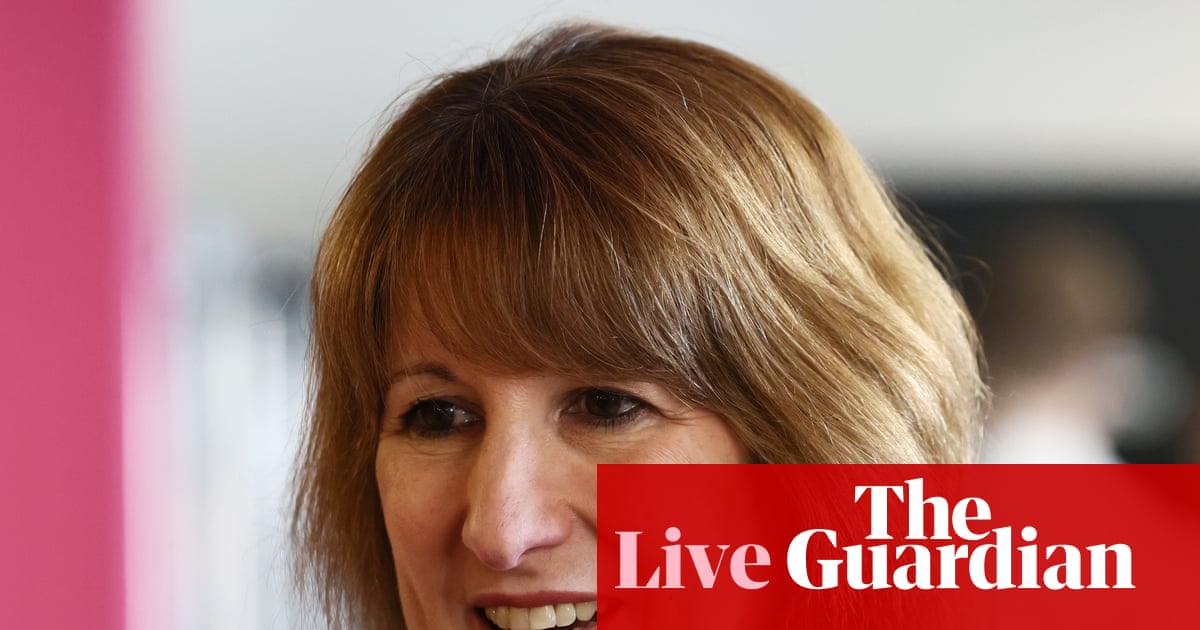
Kemi Badenoch gives speech on welfare
Kemi Badenoch is giving a speech on welfare.
There is a live feed here.
Badenoch was introduced by Helen Whately, the shadow work and pensions secretary, who said the government jobs initiative announced at the weekend meant that the government was increasing taxes on firms creating real jobs to provide subsidies for artificial jobs.
And Badenoch is speaking now. She says on Friday she did a shift in a cafe. The cafe owner was in despair at the budget, she said, because she felt that taxes were going up to pay for people on benefits.
Lib Dems urge Starmer to let Labour MPs vote for their 10-minute rule bill saying UK should join customs union with EU
Today the Lib Dem MP Al Pinkerton will use the 10-minute rule procedure in the Commons to propose a bill for the UK to join a customs union with the EU. S0-called “10-minute rule bills” never get properly debated, and never become law, but they allow an MP to make a speech in Commons “prime time” defending a particular cause. Normally there is no division when the speaker asks MPs to agree “that leave be given to bring in the bill”, but sometimes MPs object and force a vote.
Ed Davey, the Lib Dem leader, has written to Keir Starmer urging him to allow Labour MPs to vote for the bill if there is a division. Presumably the Lib Dems are hoping that Tory MPs do object, because then a division will take place and votes are recorded. For campaigning purposes, it would be helpful to Lib Dem candidates to be able to say, when given the chance to vote for joining a customs unions, certain Labour MPs did not vote, or voted against.
In his letter to Stamer, Davey said:
Even if the government retains its position of ruling out a customs union - despite the significant boost to economic growth which it would deliver - it is only right that you grant your backbenchers the opportunity to express their support for it.
The government normally tells its MPs to abstain in votes on 10-minute rule bills, on the grounds that they have no practical impact, but in October it abandoned this position to allow backbenchers vote down a Nigel Farage 10-minute rule bill calling for withdrawal from the European convention on human rights.
Victims of NHS maternity failings in England ‘received unacceptable care’
Victims of NHS maternity failings received “unacceptable care”, leading to “tragic consequences”, Lady Amos, the head of an investigation into maternity care in England, has said. Jamie Grierson has the story.
When Angela Rayner told MPs last night that the government should not “blink or buckle” on workers’ rights (see 8.58am), she was referring to the fact that, even when the employment rights bill becomes law, there are many areas where how it gets implemented remains to be decided by minister.
The Telegraph has a good example today. On its front page it has a story about the bill headlined (on its website) “Take a week off work if your distant cousin dies, says Labour”.
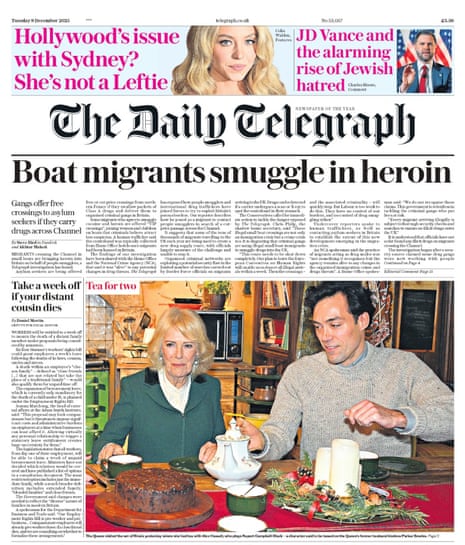
The government isn’t quite saying that. The bill will introduce a new right to statutory bereavement leave, which currently is only available to employees who lose a child. The government is going to extend that, and it is consulting on who might have to have died for a worker to qualify for bereavement leave. One option would cover wider family including uncles. The Telegraph story quotes business groups and a rightwing thinktank expressing concerns about the impact of the plan.
Angela Rayner says Labour must not ‘blink or buckle’ any more on workers’ rights as she defends compromise on bill
Good morning. Last night the employment rights bill became closer to becoming law. MPs voted out the anti-government amendments passed by the House of Lords. But they also voted to include the compromise deal negotiated in talks involving unions and business: protection from unfair dismissal starting after six months, not from day one as originally planned, and alongside that the cap lifted on compensation payments for unfair dismissal. These concessions are expected to result in peers approving the bill when they next debate it tomorrow, clearing the way for royal assent soon afterwards.
The legislation will significantly strengthen workers’ rights, particularly by giving people the right to sick pay from day one and giving workers on zero-hour contract the right to guaranteed hours.
The debate in the Commons was short and straightforward, but it included a speech from Angela Rayner, the former deputy PM. Rayner championed the bill when she was in government and, when the government announced its surprise U-turn a week and a half ago, dropping the manifesto commitment to protection from unfair dismissal from day one, it was not entirely clear how she would react. Unlike some Labour MPs, she did not denounce the climbdown in public.
Instead, she focused on getting the government to agree that the new unfair dismissal law would come into effect earlier than expected – from January 2027 instead of October 2027.
In the Commons last night, some Labour MPs criticised the compromise. Andy McDonald said that the government was making a “profound mistake”, and John McDonnell said that the government was “breaking a promise” and that it should face down the Lords instead.
But, in her speech, Rayner defended the compromises, saying that there was a need “a fair balance” and that the government had “struck the right deal”.
She said she hoped the law would now be implemented.
We have a mandate for a new deal for working people, and we must and will deliver it. That includes replacing exploitative zero-hour contracts with an offer of guaranteed hours. For low-paid workers, the security of knowing what they will earn is not just a “nice to have”; it is the basis on which they can plan their lives.
But she ended her speech hinted that any further compromise would be unacceptable.
It has been a battle to pass this bill, but progress is always a struggle that we fight for. Its passage will be a historic achievement for this Labour government. It will benefit working people now and in the future. Now is not the time to blink or buckle. Let us not waste a minute more. It is time to deliver.
Here is the agenda for the day.
9.30am: Keir Starmer chairs cabinet.
10am: Kemi Badenoch gives a speech on the economy.
10am: Sir Olly Robbins, permanent secretary at the Foreign Office, gives evidence to the Commons foreign affairs committee.
11.30am: Rachel Reeves, the chancellor, takes questions in the Commons.
Noon: Downing Street holds a lobby briefing.
After 12.30pm: The Lib Dem MP Al Pinkerton uses the 10-minute rule procedure to propose a bill for Britain to join a customs union with the EU.
4pm: Yvette Cooper, the foreign secretary, gives a speech at the Foreign Office to mark the 100th anniversary of the signing of the Locarno treaties.
Also, at some point today, the government is publishing the report from the review carried out by the Covid fraud commissioner.
If you want to contact me, please post a message below the line when comments are open (normally between 10am and 3pm at the moment), or message me on social media. I can’t read all the messages BTL, but if you put “Andrew” in a message aimed at me, I am more likely to see it because I search for posts containing that word.
If you want to flag something up urgently, it is best to use social media. You can reach me on Bluesky at @andrewsparrowgdn.bsky.social. The Guardian has given up posting from its official accounts on X, but individual Guardian journalists are there, I still have my account, and if you message me there at @AndrewSparrow, I will see it and respond if necessary.
I find it very helpful when readers point out mistakes, even minor typos. No error is too small to correct. And I find your questions very interesting too. I can’t promise to reply to them all, but I will try to reply to as many as I can, either BTL or sometimes in the blog.