.png) 2 months ago
89
2 months ago
89
A couple of years ago, 31-year-old charity worker Nicki Wedgwood had ordered Christmas presents online for friends and family. When the packages were delivered to her in Hackney, east London, the driver left them in the lobby of her building rather than taking them directly to her flat. She spotted them as she popped out to a nearby shop and decided to pick them up when she came back. When she returned 10 minutes later, the boxes had been ripped open and their contents were gone.
Wedgwood thinks she passed the thief in the hallway as she was leaving for the shop. “There was some random dude just inside the doorway, who had a Boris bike with him,” she says. She had assumed he was a guest of one of her neighbours. “I said hello to him … I think he even said Merry Christmas.”
Wedgwood and her flatmates have had “so much stuff stolen over the years”, she says. The external door to their block of flats is glass, so thieves can peer in and see packages that have been dropped off in the lobby. She believes there are thieves in her local area who follow delivery drivers on bikes “and immediately push on the door after the driver has driven off. If that’s been left open, they can just get the parcel – and a lot quicker than the person it’s for, who is maybe 15 floors up.”
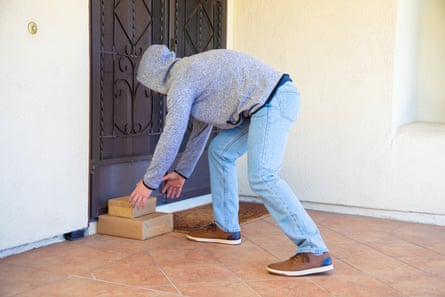
Parcel theft has become a growing issue, with parcels worth a record-breaking £666.5m reported as stolen across the UK in the last year, according to data obtained by the technology company Quadient, nearly £290m more than in 2024. And those figures are just reported thefts, while many more go unreported. Wedgwood was able to get a refund from the retailer, and says she didn’t see any point in telling the police about the incident, given that when she has reported other crimes to them: “They just take a picture and you never hear anything again.” (A spokesperson for the Metropolitan police advises victims to “always report thefts to the police”, and said it is “carrying out intelligence-led operations to catch the criminal gangs who prey on delivery vans, which has already resulted in a number of arrests”.)
Why has this crime become so common? We know that people are buying more online than ever before but, according to Gary Winter, the vice-president of global strategic initiatives at Quadient, the increase in parcel thefts isn’t just proportional to the rise of online shopping – it’s bigger than that. Winter doesn’t believe that the rise is because people are getting better at reporting it. “I genuinely think it’s becoming more frequent,” he says. “People see it as a low-level crime opportunity and are taking advantage of it.”
Leicestershire is the UK’s hotspot for parcel thefts, according to Quadient’s data (which doesn’t include figures from every British police force, as not all of them responded to the company’s freedom of information request), but city and town centres in general are where the greatest risk is. “It’s more likely that you haven’t got a safe place, that you’re living in an apartment or a multi-occupied building,” says Winter. In peak delivery season – unsurprisingly, parcel thefts are highest in December – piles of parcels can build up in lobbies and on doorsteps, and in busy areas where people don’t necessarily know their neighbours, and thieves can help themselves without too much difficulty.
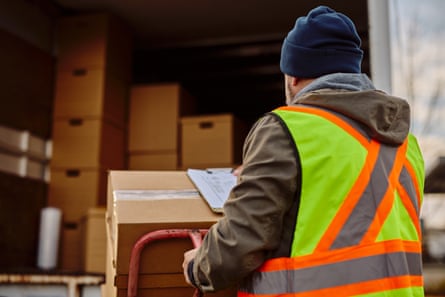
Darren Walmsley, the vice chair of the National Courier and Despatch Association, thinks part of the reason parcel thefts are becoming so common is a change in the way deliveries are made. In the past, far more deliveries had to be signed for. With a signed-for delivery, he says: “Generally, you’re physically handing it over to someone, and therefore it’s a secure delivery.” In his personal view, it was when Amazon came on the scene that things started to change. It popularised delivering items without requiring proof of delivery, having worked out that it was more cost-efficient to risk having to refund losses than for drivers to take the extra time to get a signature. Then, during the Covid pandemic, contactless delivery became more common.
Independent courier companies that offer a same-day service are “the only guaranteed service there is”, says Walmsley. Multi-job couriers tend to have much less time for each delivery: “They’ll be asked to do 100-plus deliveries a day, whereas a same-day delivery driver might do 10 deliveries a day, so they can afford to take a lot more time. For example, if someone elderly ordered something quite large, the courier would be more able to assist them to get the package inside.”
Overstretched delivery drivers leaving parcels outside, or not closing doors properly as they leave a building, “is a large part of the problem”, says Wedgwood, though she admits she wouldn’t want to do their job. The trouble is that retailers and customers tend to look for the cheapest delivery options, which usually means a lower-quality service. Walmsley advocates opting for same-day delivery when you can. “The perception is that same-day is always significantly more expensive than overnight deliveries,” he says. “However, that’s not always strictly true. The bigger an item or the higher its value, and the closer the collection and delivery locations are to each other, the more cost-effective same-day deliveries become.”
Though the value of Wedgwood’s parcels came to about £100 in total – they contained trinket gifts and books for her family – the most expensive item was only worth £30. “I definitely don’t feel like you’d get a good price for them [in the secondhand market],” she says. What can be sold on more easily, however, is branded sportswear – and Winter’s research has shown that more of these items go missing, suggesting that thieves target parcels with sports brand packaging. “We know that they end up at places like car boot sales,” he says. “They end up on eBay or Facebook Marketplace or various other platforms to be resold.”
It is not only organised criminals who are taking advantage of parcels being left outside – opportunistic neighbours are another culprit. Asif, who lives in Derbyshire, had a parcel stolen from behind his bin, where it had been left by the courier, and he suspects his neighbour was responsible. “He denied it,” says the 53-year-old. But “I could tell from his face”.
Maddie from Bristol has a little more evidence to suggest that her neighbours were the culprits when her weekly box from the meal kit service Gousto went missing. She went downstairs to her building’s basement flat to ask its student occupiers if they had seen it. “They were in the process of moving out, and the cleaner, who was conducting the end-of-tenancy clean, answered,” she says. The cleaner claimed not to have seen the box, but as Maddie turned to leave, she saw “a pile of black sacks by the door in the alleyway, and poking out of one was the patterned cold box you get as part of a Gousto. We are 99% sure it was our box as no one else in the past has had a Gousto delivery to our building.” Though it was obviously disappointing to miss out on that week’s meals, Maddie was able to get a full refund from Gousto.
Even with police involvement, it can be difficult to catch parcel thieves, although it is sometimes possible with the help of video doorbell footage – as in the case of Peter Storer, who was caught on camera stealing from a woman’s doorstep in Leicester. Even if victims don’t have any evidence, Winter says it is important to report it. “You’ve got to report it to the police because you want to be in the statistics. You want to try to make sure that the police are paying attention to this.”
Some people, of course, have taken justice into their own hands. It is testament to how widespread the frustration about this issue is that videos of doorstep thieves, or “porch pirates” as they have become known, being tricked have gone viral on social media. Pranksters have left out “bait packages” that, when picked up, will set off everything from paint bombs to glitter explosions, with front-door cameras ready to capture the thief’s comeuppance. Arizona-based software engineer Alec Armbruster, who has had a number of parcels stolen, says he enjoys watching such videos because laughing at the thieves’ plans backfiring is “the only way I can take back control”.
Several years ago, Armbruster made a prank video of his own, filling a bait package with used cat litter. “I think it took a week and a half for the box to get picked up,” he says. “I came home one day and it was gone and I was like, ‘Yes!’ I ran inside to watch the footage. It was very exciting.” He had become used to having his parcels stolen, and says he would report every one. “Typically, they would send out an officer and I would never hear about it again.” So he decided to take matters into his own hands via the prank, “which helped because it turned from something extremely frustrating to something exciting and entertaining”.
He thinks the video was popular on social media because “it’s just extremely satisfying. We’ve all had things stolen from us and it’s very invading. And we all want to see justice for things like this. If someone thinks they are stealing something expensive, like an iPhone, but what they actually get is just dust, it’s quite funny.” That said, Armbruster admits that his prank “didn’t really bring justice”, in terms of stopping parcels getting stolen. “I thought or hoped it would, which sucks.”
There are more effective steps that can be taken to prevent parcel thefts. “The brands could do more to anonymise parcels or make it less attractive or less obvious to thieves that there might be something interesting inside,” Winter says. “Carriers can re-emphasise to their delivery agents: ‘Do not put things in a stupid place, if it’s visible from the road or visible to everybody.’” Instead, they should tell them to try “knocking the door a bit harder and waiting a few seconds”, though he says he is loth to criticise the carriers because, “they’re under massive pressure to deliver such high volumes, particularly at this time of year”.
Consumers need to play their part in preventing these thefts, too, by making sure they are ordering a delivery for a day they will be in, and providing the correct address. “It’s amazing how many times we see addresses given incorrectly,” Walmsley says. He also recommends buyers consider the different delivery methods on offer. “See if they’ve got signed-for options or carriers that you’ve used before, who you know you’ve received good delivery service from.” It could also be worth getting packages delivered to your work address, he says. “Business deliveries are a lot more successful.”
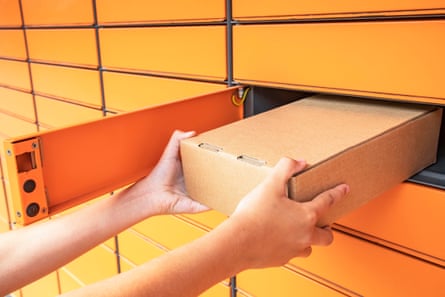
Winter agrees. “If you live in an apartment with no front garden or you’re on a street with a lot of visibility then, when you order, don’t have it delivered to home, select an out-of-home option.” He recommends corner shop and locker deliveries. He admits he has a vested interest in lockers because Quadient provides smart parcel locker solutions, but says he genuinely believes that “it’s a very convenient way to reduce that risk”.
Since Wedgwood’s parcels were stolen, she has become “quite paranoid” when she makes online orders. If she is out and receives a message to say something has been delivered, she texts her housemates to ask them to fetch it straight away. “When the buzzer goes now, we try to ask: ‘What’s the name on the parcel?’” before letting the courier in, to weed out impostors. She is not taking any chances, especially since she believes her parcel thief came back last year. “My flatmate said: ‘So weird, I’ve just come in and downstairs there was a random Boris bike left in the hallway.’ Alarm bells immediately went off,” she says.
Since Wedgwood has not had any luck asking her landlord to make her building more secure, she doesn’t expect the thieves to back down anytime soon. Unlike Armbruster, who managed to stop his parcels being stolen by moving to a more rural area, Wedgwood is not willing to find a new home because of this. “The rent is really low. I love the area. Also, I just don’t want to let the thieves win,” she says. “Why should I let them?”