.png) 3 months ago
69
3 months ago
69
I never thought it possible that you could look back on the Iraq war, and the foreign invasions of the “war on terror” in general, and feel some measure of nostalgia. For a time when there were at least concerted attempts to justify unilateral interventions and illegal wars in the name of global security, and even a moral duty to liberate the women of Afghanistan or “free the Iraqi people”.
Now, as the Venezuelan president, Nicolás Maduro, is in essence abducted and Venezuela taken over by the US, there is barely any effort to situate the coup in any reasoning other than the US’s interests. Nor are there any attempts to solicit consent from domestic or international law-making bodies and allies, let alone the public. The days of the US trying to convince the world that Saddam Hussein did in fact have weapons of mass destruction despite secretly having no reliable intelligence were, in fact, the good old days.
Maduro “effed around and found out”, said the US defence secretary, Pete Hegseth. “America can project our will anywhere, any time.” The US will now “run Venezuela” said the president, Donald Trump. “We are going to have a presence in Venezuela as it pertains to oil.” There is little to no effort to make reasonings for the takeover cohere. It is claimed that Maduro is guilty of “narco-terrorism” and other charges including “Conspiracy to Possess Machineguns [sic] and Destructive Devices against the United States” – charges that not only fail to clear the bar required for invasion and abduction, but also apparently are not even taken that seriously by Trump himself. Others charged with drug offences have been pardoned. Among them are Honduras’s former president Juan Orlando Hernández and Ross Ulbricht and Larry Hoover, both released from life sentences for convictions including drug trafficking.
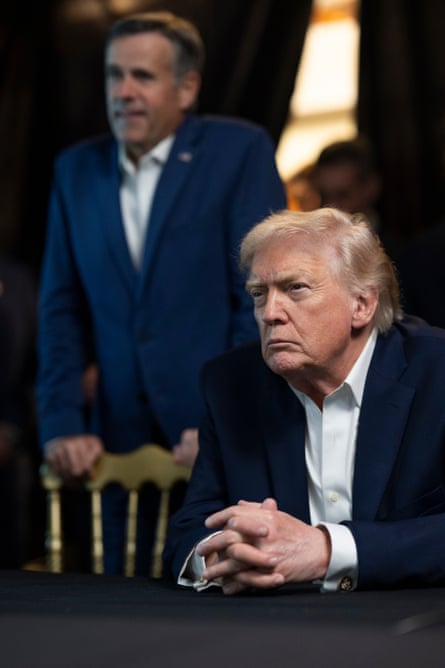
The point, as demonstrated by triumphalist posts on social media that include hip-hop-soundtracked montages and Trump as a sort of gangster in chief, is in the very rebuke of the notion that US actions are subject to due process. The Venezuela coup is not an exhibition of the long arm of the law, but the fact that the US is the law and is not subject to any higher one, able to wield its extraordinary power and lethality in the dead of night, kill dozens of innocents and face no consequences, let alone censure.
And the response so far has proven this to be correct. These extraordinary scenes, actions and statements are already being passed into the realm of the normal by the sort of bland, hedged statements that we have grown accustomed to. Several politicians and heads of state have engaged in the sort of feeble and contradictory statements they make when their kind of diplomacy collides with the reality that their allies are out of their minds. Keir Starmer says that the situation is “fast moving” and that he will “establish all the facts”, just as the facts are marching Maduro on a perp walk in Brooklyn. The EU Commission president, Ursula von der Leyen, is “following very closely the situation in Venezuela … any solution must respect international law and the UN Charter”. EU foreign policy chief Kaja Kallas reassures us that it is “closely monitoring the situation”, as is the Australian government and others.
What you will be reminded of with increasing frequency, once there are no more facts to be established or live situations to monitor, is that Maduro was a very bad man. Even if the importance of international law is proclaimed, it will be done in tandem with condemnation of Maduro. The British foreign secretary, Yvette Cooper, always out in front, leads the charge with this platonic ideal. Point number one, she tweeted on Saturday: “The UK has consistently rejected Nicolás Maduro’s legitimacy, and called for a peaceful transition of power in Venezuela.” Two, she added: “As the prime minister has made clear, we support international law. Our collective focus must now be on achieving a transition without bloodshed to a democratic government.” Note that there is no acknowledgment that international law was already violated, and by whom – only that it is supported, but apparently in no ways in which it can actually be upheld.
The upshot is that we kick off a year in which the die is cast. The Venezuelan incident will shred whatever little remained of the pretence that there is any will to stand up for norms that underpin global security – that sense that there will be consequences, either material or social, that deter land grabs, annexations or regime changes. The world is already ripe for such a moment. The Middle East is a hotspot, maturing into a competition between rising Gulf states, and further unsettled by an unfettered US and Israel. We see this in Palestine, Syria and Lebanon. It is a mere blip on the news map now, but Saudi Arabia and the United Arab Emirates, two powerful, previously close allies with increasingly ambitious regional agendas, are facing off over Yemen and the sides in the conflict that each support there. The escalation in rhetoric and military action – Saudi Arabia struck a UAE shipment of combat vehicles headed for Yemen and accused the country of endangering its national security – opens an unprecedented front in the Gulf.
Such chaos has already been enabled by the UAE’s new questionable, imperial role in the region and beyond in Sudan’s cruel war, and that country joins the club of nations that face no repercussions. On the other side of the Gulf, protests in Iran are in their second week and have already captured the interest of Trump, who has threatened more strikes, taking the prospect of US-led regime change there out of the realm of the unlikely. As is Trump’s threatened annexation of Greenland.
Other improbabilities become possibilities. China is performing military drills around Taiwan. Vladimir Putin needs little encouragement, but the Trumpian doctrine of imperial dominion and discretionary right to launch military campaigns now mirrors Putin’s own, and further imbues Russia’s actions in Ukraine with validity. After Venezuela, you would be mad, if you were a regime with some measure of financial and military strength and regional ambition, not to test the waters at least.
The tepid response from those who still feel the need to restate support for international law does nothing but contribute to this state of encouraged predation. The situation in Venezuela cannot be contained with peaceful transition (which is unlikely if the entirety of recent history is anything to go by). Just as Gaza could not be contained. One could argue that it is wise not to anger Trump – not even with a statement of the truth of his actions – and ask what a country such as the UK could do anyway. But resisting the violation of rules and insisting on adherence, even if certainly in vain, is how norms are established and then maintained. Lying low and hoping that this too shall pass is cowardice, denial and historical illiteracy.
The consequences will be reaped increasingly, and not just by the unfortunate in faraway places. Fences, both practical and notional, that maintained a settlement – fragile and flawed, but a settlement nonetheless – are being dismantled. Silence is not safety. It is, to use the language of the day and channel the jubilant Hegseth, “effing around” and “soon finding out”.
-
Nesrine Malik is a Guardian columnist