.png) 2 months ago
63
2 months ago
63
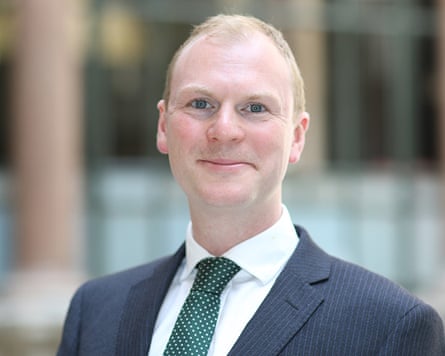
Augustus James Ulysses Jaspert, Gus for short, arrived in Tortola, the largest of the British Virgin Islands, on 21 August 2017, just two weeks away from catastrophe. Jaspert, who was in his late 30s, had recently been appointed governor by Queen Elizabeth II, on the recommendation of the Foreign Office in London. The BVI is an overseas territory of Britain, with only partial independence, and the governor effectively acts as a backstop to the locally elected legislature. For Jaspert, a career civil servant, it would be his first hands-on experience of governing – and his first time in the British Virgin Islands. Any trepidation was outweighed by the prospect of moving to the Caribbean. “If you’re sitting in an office in London and someone says, ‘Go to Tortola,’ you look it up on a screen and think, ‘OK, I can do that,’” Jaspert told me.
While Jaspert, his wife and two sons were settling into their new life, a tropical storm gathered over the Atlantic. At first, forecasters weren’t unduly alarmed, but in the first days of September, the storm transformed into something much worse. In the afternoon of 6 September, Hurricane Irma made landfall in Tortola, which is home to the majority of the BVI’s 30,000-strong population. Irma was one of the strongest hurricanes ever recorded in the Atlantic basin. It scalped buildings, blew out windows and removed entire floors from homes. Shipping containers smashed into the islanders’ fishing boats and the out-of-towners’ yachts.
Jaspert rushed his family into the bathroom of the governor’s residence, an imposing white-stucco mansion lined by porticos which, only finished in 2003, was newer and sturdier than many islanders’ homes. (The original Government House structure, dating back to the late 19th century, was destroyed in a 1924 hurricane.) If the roof fell in, Jaspert reasoned that he could at least upend the bath tub to create an air pocket until help arrived. Ordinary islanders, many of whom live in squat bungalows or ageing low-rise apartment blocks, had few such options.
The next day, as the gales died down and flood water continued to rise, islanders emerged to a territory in ruins: four in every five buildings in Tortola was either damaged or destroyed. The damage ran into the billions of dollars, larger than the territory’s entire GDP. Though the death toll was mercifully low – officially, only four people – around half the population were left homeless.
Islanders, a tight-knit community, began the work of rebuilding their homes, but the official reconstruction effort ultimately fell to two men: Jaspert, only a fortnight into his governorship, and Dr Daniel Orlando Smith, the elected premier of the territory, a surgeon turned politician who had led the islands since 2011. Jaspert and Smith had limited information, no working electricity and barely any internet connectivity. Life-and-death decisions about water distribution, food provision and emergency shelter for homeless people had to be taken on the fly in the basement of the territory’s only hospital.
The problems that had festered on the BVI long before either Jaspert or Smith took up their posts – corruption, nepotism, meagre accountability – were thrown into sharp relief now that islanders depended upon government for their basic necessities. The constitution, which attempts to neatly parcel power between locally elected politicians and a British governor, strained at the seams. “If you’re a governor who pushes and tries to clean things up or to take action, you very quickly get a wall of stuff coming back at you,” Jaspert told me.
One point of contention was the reconstruction loans. Britain demanded that any loans be overseen by an independent body to prevent money being siphoned off by corrupt officials. Some elected ministers saw such demands as an attempt to install a kind of “alternative government” that undermined their authority. “What [the British] have done to us is a disgrace,” one politician declared at a public meeting in 2018.
In the stalemate of mutual mistrust, money failed to reach those who needed it most. Poor islanders had borne the brunt of the storm, and were the last to be helped in the recovery that followed. Seven years after the hurricane, in the heart of Road Town, the BVI’s capital, across the road from the government administration building, a residential apartment block still stands in ruins today.
On 25 February 2019, Virgin Islanders headed to the polls. Angry with the lacklustre recovery, they swept Orlando Smith’s party from power and granted a landslide victory to the pro-independence Virgin Islands party, led by Andrew Fahie, a formidable politician who promised radical change. “We will take our Virgin Islands to heights never seen before economically, socially and morally,” Fahie promised in his first address to the House of Assembly.
Jaspert didn’t see much cause for concern. He and Fahie had met regularly while Fahie led the opposition. Fahie’s anti-imperialist politics might make for friction, but after the devastation of Hurricane Irma, Jaspert was confident that whatever was in store couldn’t be worse than the almost two years the Islands had just survived. It was the second time Jaspert would be wandering into disaster. This one was entirely human-made.
Andrew Fahie was a big fish in an exceedingly small pond. He was heavy-set, with a buzz cut and a closely-shaven goatee. At public events, he was charming and charismatic, a back-slapping man-of-the-people who spoke passionately about his Christian faith and unshakeable belief in the people of the Islands. He sought to spread a message of optimism about a future in which the Virgin Islands, after about 350 years of British rule, might one day complete their “journey” to self-determination.
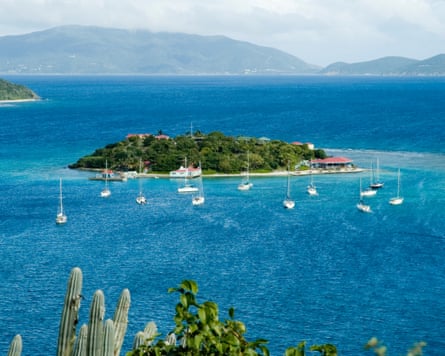
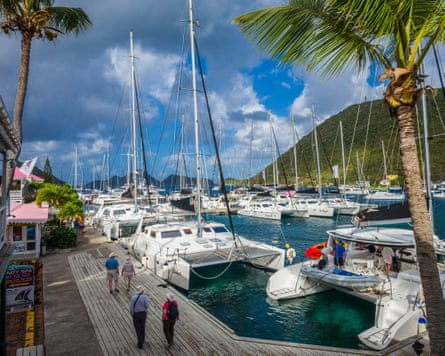
In a place as small and interconnected as the BVI, charm is essential. “Everyone knew Andrew,” one elderly islander told me in Road Town, though that wasn’t saying much. “Everyone knows everyone,” she added quickly. When I visited in early May, the Islands’ peak tourist months were over, and the humid air signalled the approach of hurricane season. Road Town, a warren of tired hotels, colourful tourist shops and offshore law firms, often felt eerily empty. On the marina, around which the town curves, hundreds of millions of dollars of yachts bobbed idly in the clear waters. Stripped of tourists, the capital felt more like a village: a place in which everyone can spot an outsider, and as I learned, nobody feels free to talk.
The territory that Fahie came to lead in 2019 was very different from the territory he was born into in 1970. The son of a shopkeeper, Fahie wasn’t a member of the local elite, nor did he benefit much from the changes that swept through the islands during the 1980s, when local entrepreneurs and lawyers were developing the two industries on which the BVI now depends: tourism and, above all, financial services. Thanks to a coterie of local, British and US lawyers, the BVI became a global leader in selling anonymous shell companies to people looking to park assets in a tax-free location. (At present, there are more than 355,000 corporations registered in the BVI – more than 11 times the number of human residents.) A few locals grew wealthy, while billionaires from abroad, including Richard Branson, bought private islands. Ordinary families such as Fahie’s were largely left behind.
As a young man, Fahie dedicated himself to public service: after obtaining a degree in education in Florida, he became a maths teacher, then an assistant principal of Tortola’s largest secondary school. In a small territory where, at most, 15,000 residents are “belongers” – the territory’s equivalent of citizens with the right to vote – familiarity is a potent form of political capital. His easy charm and deep roots in his community earned him a landslide victory when he decided to run for office in 1999. At the age of 28, Fahie was elected to the Legislative Council, the forerunner to today’s House of Assembly, the 15-member parliament of the islands, and took on the role of minister of education.
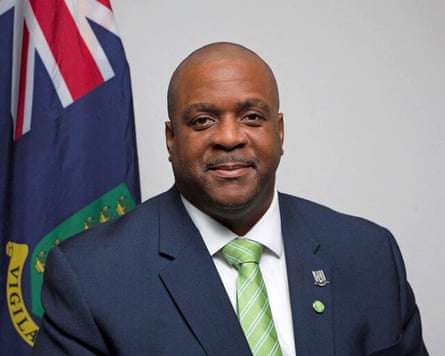
Two stints in government allowed Fahie to establish his political brand, as a devout Christian from humble origins, here to represent the people. But it was on the opposition benches during the 2010s that he came into his own, fashioning himself as an anti-corruption crusader. Despite his anti-imperialist politics, Fahie demanded that the British launch corruption inquiries into his political rivals.
In November 2016, Fahie became leader of the opposition. While he was sceptical about Britain’s role in the territory, British officials told me they had found Fahie affable, largely collegial, someone they felt they could work with. “The big flip was the election,” Jaspert told me.
Emboldened by his victory in 2019, Fahie was determined that no one would stand in his way, least of all a British governor 10 years his junior. “This will not be business as usual, but rather business unusual, business unconventional,” Fahie told the house at the start of his tenure. Jaspert had no idea quite how unusual Fahie’s premiership would turn out to be.
Fahie’s election parades had barely concluded when he issued a surprising request to Governor Jaspert and Mick Matthews, another Brit, who had served as commissioner of police since 2016. Fahie wanted a private security detail, provided by a firm of his choosing, and he wanted them to be armed.
“Having private security officers running around with guns in this territory was my worst nightmare,” Matthews told me. A wiry man in his 60s with silver hair and a deep tan, Matthews had rarely felt in need of a firearm in four decades of policing, either in the UK or BVI. The islands – located between the world’s largest cocaine producer, Colombia, and one of the world’s largest cocaine consumers, the US – is a crossroads for drugs flowing north and American-made guns heading south, but its violent crime rate was, compared with its neighbours, relatively low. Matthews denied the request, but couldn’t shake the question of what it was – or who – that scared Fahie so much that he wanted armed guards.
Behind closed doors, tensions between Fahie and Jaspert started to grow. Under the constitution, the locally elected government runs most domestic affairs – education, welfare, spending, public works – while the governor has control of national security, foreign affairs, the courts and public servants. But under Fahie’s administration, laws began to be produced at a moment’s notice. Minutes of meetings, never well kept, stopped being recorded altogether. “The basic functions of how a state works were being undermined,” Jaspert told me.
Fahie had little time for the objections of the British. He believed he had a mandate to shake up the islands’ institutions, even if it meant pushing at the limits of the law. He started with the administrative bodies, usually run by locals, which help to administer the ports and airports. He fired the boards en masse. Among his new appointments was a man who had once served a prison sentence for misconduct in public office. When challenged on this by an official, Fahie brushed aside objections.
A few months into Fahie’s tenure, as suspicions about Fahie’s disregard for checks and balances were mounting, Mick Matthews had a startling conversation with a local police officer. This wasn’t the first time there had been questions about Fahie’s integrity, the officer said. Fifteen years earlier, at the end of Fahie’s first stint in government, the BVI’s police force had opened a criminal investigation into him.
Rumours that Fahie had previously been under investigation for money laundering had long swirled in the territory. In the run-up to his election in 2019, reporters had asked him about it. Fahie had denied the allegations, describing them as part of a witch-hunt. After his election, in late 2019, a public servant went searching for the police investigation files in Tortola. “We knew there had been a case,” the official told me, but, they discovered, “the file had disappeared”. It was not clear whether the file had been lost or deliberately removed. Whatever the explanation, Jaspert and Matthews were left with nothing more than rumours.
In March 2020, the Covid-19 pandemic further strained Jaspert and Fahie’s fraying relationship. Fahie announced a lockdown, and Jaspert relayed an offer of assistance from a Royal Navy ship to secure the borders. (Matthews had intelligence that boats were still entering the territory, carrying people, weapons and drugs.) Fahie was incensed. The intervention of the British navy was, in his view, naked colonialism: what better way to undermine the authority of elected officials than shunting a warship into BVI waters?
Instead, Fahie forced through his preferred solution: three floating barges, owned by a local man, equipped with radar to detect incoming boats. Given that most of the police’s fast boats were out of commission, in part because Fahie had blocked pleas to fund the repairs, Matthews didn’t see the point. But Fahie pressed on, spending $2m on deploying three barges, none of it signed off by cabinet in advance. Matthews began to wonder whether Fahie wanted to stop people and drugs coming into the territory, or simply know when it was happening.
At the same time, worrying reports were coming in from ordinary islanders. Fahie was leasing some of his family’s land to Nyron Erickson, a drug dealer wanted for a slew of narcotics and weapons charges. Locals also claimed that Fahie’s election campaign had received generous donations from Bob Hodge, a cocaine kingpin who had dodged three attempts to extradite him to the US. (It is impossible to verify this claim because there is no obligation to declare political donations in the BVI. Hodge was killed in 2021.)

In September 2020, with concerns rising about organised crime infiltrating the territory, Jaspert lost patience. Without Fahie’s agreement, he declared that the navy ship would be returning to the BVI. Fahie was apoplectic. He wrote furious letters to Baroness Sugg, then minister for overseas territories in the Foreign Office, accusing Jaspert of “political sabotage”, “malicious actions … designed to … reinforce Britain’s colonial status quo in the BVI” and threatened to report Jaspert’s “act of aggression” to the UN.
Fahie’s fury escalated to open threats. Matthews was witness to some of the blow ups. On more than one occasion, Fahie told Jaspert he was having him followed. He said it would be “safer” if Jaspert went home to London. At one meeting, he allegedly told Jaspert, “I will destroy you.” Matthews tried to keep out of political discord – it wasn’t his job to adjudicate between a premier and governor at war – but neutrality had become impossible. Shortly before Fahie’s letters to Baroness Sugg, “Fahie called me to his office and asked me to arrest Gus,” he told me. Matthews asked on what grounds he was expected to arrest the sitting governor. Fahie said Jaspert was bullying him.
To Matthews and Jaspert, Fahie no longer seemed like a single-minded leader willing to break norms to get his way; he seemed like someone deliberately undermining the rule of law. Neither Matthews nor Jaspert would disclose any information about conversations they may have had with British authorities. But by the end of autumn 2020, the UK’s National Crime Agency had approached the US Drug Enforcement Agency (DEA), and learned the DEA had its own interest in the BVI. Neither Jaspert nor Matthews were apprised of the two agencies’ backchannel discussions. Both men thought they were effectively on their own, and were concerned about their safety. Fearing their offices had been bugged, they began to meet in remote locations.
On the evening of 6 November 2020, a team of Virgin Islands police raided the property of a serving BVI police officer and uncovered 2.4 tonnes of cocaine with an estimated street value of $250m. “It was the biggest seizure of cocaine in [BVI] history, with corrupt police officers’ hands all over it,” said Matthews. In emergency meetings, Matthews informed the premier and the governor of the news. “Gus nearly fell off his bloody chair when I told him how much there was,” Matthews recalled, “But I can never forget telling Andrew Fahie that this is the biggest seizure in history, and he didn’t blink.”
For Jaspert, it confirmed his decision, long brewing, to call for a commission of inquiry – an independent, judge-led inquiry into an overseas territory when the governor fears corruption or serious dishonesty in public office. “I am a very resilient person,” Jaspert told me, “but [by that point] I was very close to broken.” By 18 January, when Jaspert came to announce the inquiry, Fahie had blocked Jaspert’s use of the government’s communications department. Jaspert had to procure a selfie stick and record his announcement to post on Facebook. It was his last act as governor before leaving the Islands for good. “I had to film it myself,” Jaspert recalled. “That’s why it looks a little bit like a hostage video.”
The announcement of the commission of inquiry sent tremors through the Virgin Islands. The last one Britain had called, in the Turks and Caicos Islands in 2008, had resulted in the territory being forced into direct rule from London for two years. Many islanders were torn: local politicians “were taking advantage”, one elderly islander told me. (Everyone who agreed to speak to me said the same.) Yet the threat of a takeover by the islands’ historical coloniser sat extremely uneasily with a population that is 79% African-Caribbean and yet has never had a Black governor. On the blogs and message boards where much of the Islands’ political infighting takes place, one commenter put it this way: “The colonialists will remain colonialists and slave masters like a leopard that will never change his spots.”
Publicly, Fahie welcomed the commission as a chance to “clear the air”. In private, Fahie’s government geared up for a fight. Fahie’s government hired Withers, a global law firm, to represent “the government of the Virgin Islands”. The legal team was headed by Geoffrey Cox KC, who had been attorney general of the UK from July 2018 until February 2020, and was still Conservative MP for Torridge and West Devon.
Cox’s involvement shocked some observers of the inquiry. Some noted that, as a former attorney general, there was a risk that he could end up using information accessed in public office in pursuit of private practice. To others, the spectacle of a serving British MP earning huge fees defending a client from another arm of government, the Foreign Office, seemed absurd. “I cannot see how this was not a conflict of interest,” said one participant. The fact that Cox had flown to BVI during a strict Covid lockdown in the UK did not help matters. For some islanders, the most egregious element was the fees charged by Withers: $6.5m from Virgin Island government funds. (Withers declined to comment for this article, and Cox did not respond to numerous approaches.)
On 4 May 2021, the commission held the first of 55 hearings that took place over the following six months. Participants submitted statements, provided documentary evidence – albeit often late, and in “shambolic” form, according to the final report – and sat through cross-examination by the commission’s counsel, Bilal Rawat, a British barrister.
Corruption, the inquiry heard, was nothing new in the BVI. The inquiry heard evidence of Fahie’s predecessors handing lucrative contracts to family members without adequate checks, spending $7m on a national airline that never launched, and obstructing auditors. In one case, a simple project – the extension of a school wall – was split into 79 contracts, delivered vastly over-budget, and left uncompleted. Sonia Webster, the BVI’s auditor general, whose reports exposed malfeasance long before the British called the inquiry, patiently explained the various ways she had been ignored and obstructed by local lawmakers. Her conscientiousness was not appreciated: she was pilloried by the attorney general for making “deplorable” comments. Victoreen Romney-Varlack, whose former job it was to maintain a register of politicians’ business interests, was being threatened with criminal investigation for telling Governor Jaspert that most of the legislature had failed to declare their interests. (Webster declined to speak for this article. Romney-Varlack did not respond to requests for comment.)
Fahie was at ease hearing his predecessors’ failures. But over the seven days in which he was questioned, he faltered. He struggled to explain why projects he oversaw had ballooned in cost and delivered no discernible results. Grants to religious institutions, an important part of his support base, were 662% over the recommended budget. Consultants charged extortionate fees for projects that never materialised. And Fahie’s cabinet, with Fahie present, had attempted to expedite the citizenship application of a convicted rapist who was then serving time in jail overseas – despite a residency requirement for applicants.
Fahie tried, throughout, to maintain an air of calm, but on 12 October 2021, his sixth day of evidence, he became increasingly erratic. Visibly exhausted, he answered yes-or-no questions with rambling monologues on how unfairly he had been treated by the commission, former foreign secretary Dominic Raab, the media, the UK government and seemingly anyone else who came to mind. He suggested, more than once, that he was in danger. (He never specified from whom.)
The day’s hearing was intended to discuss the Covid-19 stimulus package. But Fahie veered more and more dramatically off-script. Finally, the hearing reached its strange climax.
Citing a report which suggested opaque and wasteful spending on Covid assistance grants, the commissioner asked a simple question: “Don’t you have some sympathy generally with the auditor general’s report?”
Fahie’s response was instant: “Commissioner, who has sympathy for when this whole inquiry was launched on me? When my wife and my picture [appeared] in front of marijuana drugs and have the world thinking that the BVI has a premier that’s a drug lord and a drug cartel? Who has sympathy for me?”
Fahie’s lawyer Niki Olympitis’s eyes darted across the room. A bemused commissioner raised a hand to speak. At no point had the commission suggested that Fahie was in any way involved in the drugs trade.
“How was that the responsibility of the auditor general?” asked the commission’s barrister.
“No, no,” Fahie began, before trying to change the subject. Fahie’s subsequent rambling about an alleged conspiracy between the auditor general and Dominic Raab did little to mask the strangeness of his eruption. In retrospect, the outburst came to seem more like a confession.
On 16 October 2021, four days after Fahie’s outburst and a month before the commission of inquiry held its final hearing, a man by the name of Roberto Quintero appeared in Tortola. He set up a meeting with a group of men connected to the territory’s criminal underworld and explained to them that he needed to secure safe passage for shipments of cocaine through the Virgin Islands. The trio agreed to make introductions to Oleanvine Maynard, who ran the BVI ports authority.
Five months later, in March 2022, Quintero met Maynard in a waterfront restaurant in St Thomas, the second-largest of the US Virgin Islands, an hour’s boat ride from Tortola. Quintero said he worked for the Sinaloa cartel, one of Mexico’s most violent gangs, and used coded language to avoid detection – he referred to cocaine as “number three” – but Maynard understood what he needed: a paper trail to ward off prying eyes. “You want it to be done legally, so nobody will snoop around,” she said. “That is where I can assist.”
Maynard said that she needed buy-in from her superiors, including Fahie. “You see with my premier, he’s a little crook sometimes,” she confided, disregarding Quintero’s careful euphemisms. She said her son would reach out to Fahie and broker a meeting. In return, Quintero handed her a bag containing $10,000. “Give me your hand,” he said, “Welcome to the Sinaloa cartel.” Two days later, Maynard’s son spoke to Fahie and WhatsApped Quintero the good news: “Head coach wants to play with the team this season.”
On 7 April 2022, as the commission of inquiry report was being prepared, Fahie and Quintero had their first face-to-face meeting in a luxurious house in the East End of Tortola. Quintero laid out the scheme in detail. Twice a month, cocaine refined in Colombian labs would be shipped to Tortola, concealed in 5kg buckets of waterproofing paint. Each shipment would contain three tonnes of cocaine. The cargo would then move to Puerto Rico, before being sold in Miami and New York for up to $38,000 per kilo. If all went well, Fahie’s cut would be about $8m. Quintero suggested that they could even arrange the seizure of a couple of low-quality shipments so Fahie could present himself as tough on drugs. All Quintero needed was 48 hours after arrival without any unwanted checks of the cargo.
“You’re not touching anything,” Quintero said.
“I’ll touch one thing,” Fahie replied. “The money.”
Almost three weeks later, Fahie and Quintero met in Miami to iron out the finer points of the operation. The two men talked loosely. Fahie boasted about his connection to a seasoned trafficker of drugs and weapons in the BVI who was “like a brother” to him. He confirmed he would be able to bribe a government official who could threaten their scheme. And he lamented past deals where partners had betrayed him; he reckoned he had missed out on about $7.5m over the previous two decades.
When Quintero cautioned Fahie not to discuss anything over the phone, Fahie reassured him. He explained that when he’d handled illicit cash in the past, shrink-wrapped in plastic, he hadn’t just binned the wrappers, he had burned them, in case they could be traced. Quintero was impressed: “So this is not your first rodeo, right, I can tell,” he said. Fahie laughed: “No no no, not my first rodeo at all.”
The following morning, on 28 April 2022, Quintero drove Fahie and one of his daughters to Miami’s Opa Locka airport. Fahie had a flight to catch, and it was a chance for Quintero to show Fahie the money. Upon arrival, Quintero led Fahie into a small plane containing the cash: $700,000, stacked in designer shopping bags. Half a million dollars of it was earmarked for Fahie, a bribe for his participation. Fahie inspected the money and, suitably convinced, left the plane. The deal was done.
What Fahie did not know was that Quintero was not a Sinaloa trafficker. He was a confidential informant feeding every text message, every phone call and every conversation straight back to the DEA. As the premier exited the plane, agents placed him under arrest. Fahie’s protestations – “Why am I getting arrested? I don’t have any money or drugs” – fell on deaf ears. (Oleanvine Maynard and her son were arrested later that morning.)
When the news of Fahie’s arrest broke, islanders “were really disappointed, really let down,” said one long-serving local police officer. “What stupidness that is.” Others simply didn’t believe it. One elderly islander told me she didn’t understand how Fahie could face jail time for a “prank”, which is how she referred to the DEA sting. Gus Jaspert, for his part, felt a kind of relief: “I felt vindicated that I was right to bring things to a head … that I was not mad.”
As it happens, had Jaspert seen the police documents that went missing in Tortola – and which I managed to obtain during the course of my reporting – he may have had fewer doubts. They show that in 2002 and 2003, Fahie had been accused by BVI prosecutors of leading a money-laundering ring that moved tens of thousands of dollars into the US illegally. The documents allege that Fahie had been interrogated by police, and conspired to “lie to investigators about [his] financial dealings”. Ultimately, no charges were brought. Three sources linked to the original investigation told me that this was due to a lack of political will, gaps in the evidence and fear on the part of the participants to testify in open court. (In a close-knit territory, snitching is a particularly potent form of betrayal and comes with obvious risks.)
Where local prosecutors failed, the DEA succeeded. Last year, in a Florida court, a jury unanimously found Andrew Fahie guilty of cocaine trafficking and money-laundering conspiracies. He was sentenced to 11 years in federal prison. (In response to a detailed list of questions, Fahie’s lawyer said our piece contained “erroneous observations” but declined to comment, citing his ongoing appeal.)
Before Fahie’s arrest, the British government had been planning for an orderly rollout of the commission of inquiry, with invitations for BVI ministers to come to London to discuss its findings. The day after the arrest, those plans were scrapped and the damning 937-page report was published in full. “Almost everywhere, the principles of good governance, such as openness, transparency and even the rule of law, are ignored,” the commission stated. “There is a void where governance procedures, checks and balances should be.” It concluded that “the people of the BVI have been badly served in recent years. Very badly indeed.” The commission proposed that the islands’ constitution be suspended and the territory taken into direct rule from London.
The reaction on the BVI was furious. Pro-independence islanders gathered at the governor’s residence to protest against what they saw as a colonial power grab. Ordinary Virgin Islanders did not need to be told by a British inquiry that their elected officials were taking advantage of them. They had lived it. Yet almost no islanders thought the best solution to their problems was direct rule by Whitehall civil servants.
In truth, the UK government also had little interest in the expense and manpower that direct rule entailed. (Exact figures on the cost of taking the Turks and Caicos into direct rule are not publicly available, but Westminster extended a £160m loan guarantee in 2011.) A solution was found that half-suited everyone: a new coalition government was formed, headed by Fahie’s deputy, Natalio Wheatley. Islanders remained in control, and with a change in leader, Britain had an alibi for staying out.
The Foreign Office told me that it defends its decision to call a commission of inquiry and cited its long history of support for the islands. The BVI government said it has “delivered the most robust governance reform in the history of the Virgin Islands” and welcomed the UK’s decision to drop its threat to take over. “We are progressing strongly, building a stronger, more resilient Virgin Islands that can chart a course of transformation and deliver progress for the territory and its people,” said a spokesperson.
“There is still a fundamental belief here that there’s a British conspiracy to take over, boot the government out and run the country,” Mick Matthews told me, driving down the coast of Tortola as storm clouds gathered on a rainy May afternoon. “Andrew Fahie was using that as leverage, playing on people’s fears.” But for Matthews – who is one of the very few British officials to have stayed in the Islands after his employment concluded – the opposite is true. “If anything, there’s a conspiracy to have done bugger all.”
On Tortola in early May, a year on from Fahie’s conviction, Virgin Islanders fell silent when I mentioned his name. Few were eager to return to the subject of his arrest or the commission of inquiry. (The government of the Virgin Islands, the governor and numerous public officials refused or ignored repeated requests for an interview.) “People here don’t always want to hear the truth,” said one elderly islander. The community is close and they have deep pride in the territory they have built from the ashes of slavery, she explained. It also makes open criticism seem like a kind of betrayal. (None of the islanders I spoke to were willing to be named.)
Some in the Islands had seen tentative signs of improvement. A dizzying array of new laws and regulations are making their way through the legislature. Criminal investigations into the misuse of public funds recommended by the commission are now under way. And Britain has formally dropped its threat to take over. But the roots of the BVI’s problems persist: a tiny political scene struggling to shed allegations of nepotism, a creaking justice system, chronic underfunding of the police.
The relationship between Road Town and London remains defined by mutual mistrust. Nobody I spoke to had any affection for the British, but nor did they think independence was viable until their own politicians could be trusted. Caught between a domestic elite concerned with their own enrichment, and a colonial power demanding economic and political reforms without promises to fund them, the Islands remain in postcolonial purgatory.
The territory, historically insulated from some of the violence plaguing neighbouring Caribbean islands, no longer feels safe to many of the people who live there. One evening during my time in BVI, a source texted me with the news that Nyron Erickson, the 32-year-old drug trafficker to whom Andrew Fahie’s family had rented land, had been murdered in the West End of Tortola. An audio recording of the incident captured the staccato fire of a handgun, followed by the thrum of a submachine gun. “They emptied a whole clip,” said one resident. “It was an execution.”
In Road Town, five miles east of the police cordons around Erickson’s body, the House of Assembly was closed for the weekend. Inside the house is a wooden board with portraits of the territory’s former leaders set in two neat rows. There are only six faces. Fahie’s portrait, with a glib half-smile, remains in place. Already, Fahie’s rehabilitation appears under way. In a recent spat with the current premier, a member of the opposition railed against the current administration’s botched infrastructure projects. “If Andrew Fahie were premier, he would fix roads, water and everything else that we need. I’ll stand on that,” the opposition member said. The current minister for works, Kye Rymer, responded: “The strange thing is, at one point, they wanted to take down [Fahie’s] picture, saying he shouldn’t be on this wall. But this man contributed to this territory and I’m happy to hear the endorsement.”
Back in the West End, a short way from where Erickson was killed, a house midway up Zion Hill stands in ruins. Only the first two floors are built. Steel rods poke up through the breeze blocks. It looks like the beginning of something grand – a palatial home overlooking the narrow channel separating the British Virgin Islands from their American counterparts. It belongs to Andrew Fahie. Works ground to halt upon his arrest. They are unlikely to be completed any time soon.
This article is a collaboration with the Bureau of Investigative Journalism, and support was provided by a reporting grant from the Pulitzer Center
The best stories take time. From politics to philosophy, personal stories to true crime, discover a selection of the Guardian’s finest longform journalism, in one beautiful edition. In the new Guardian Long Read Magazine, you’ll find pieces on how MrBeast became the world’s biggest YouTube star, how Emmanuel Macron deals with Donald Trump, and shocking revelations at the British Museum. Order your copy today at the Guardian bookshop.