.png) 3 months ago
56
3 months ago
56
On the main street of Metula on Thursday morning there was one thing everybody agreed on: the night had been “difficult”.
The sirens had fallen silent only a few hours earlier when military authorities were sure there would be no further waves of attacks with rockets and drones on targets across northern Israel launched by Hezbollah, the Lebanon-based militant Islamist movement, and its sponsor, Iran.
Yet any calm was fragile and partial.
Warplanes flew low over the small town, the northernmost community in Israel, and the loud percussive bang of interceptions of missiles came frequently. In the background was the thud and crack of what residents drinking coffee in the Bela cafe said was Israeli artillery firing not far away.
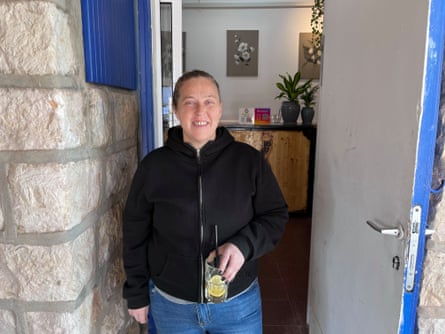
Miry Menashe, the co-owner of Bela, said she had kept the cafe open because “the people of Metula don’t run away from rockets”.
“We want to keep a bit of sanity for us, for the residents, for our soldiers. They come a lot these days so we want them to have a place to relax, have a beer, a coffee, something to eat, just to keep life going,” Menashe, 41, said.
Shragan Shatil, 77, had come to the cafe with neighbours. He said the war that has closed schools, offices and businesses across Israel would end only when “Mr Trump decides” and even then Israel could press its offensive against Hezbollah alone.
“Last night was tough. The last days have been the toughest. It was very bad. There is usually a break afterwards … then in the evening it starts again … Now we are drinking coffee in the sun,” Shatil, who has lived in Metula for 29 years, said.
Israeli military officials said Hezbollah’s attack on Wednesday night and Thursday morning involved about 200 rockets and missiles as well as 20 drones. For the first time, such a barrage was timed to coincide with a salvo of missiles from Iran.
No one was killed by the attacks, though they inflicted extensive damage to property. So far 12 have been killed in Israel by Iranian missile strikes in the war, and hundreds injured.
Hezbollah’s operation, called “Operation Chewed Wheat” – a reference to a Quranic verse about reducing your enemies to chewed wheat – was a sharp escalation by the group, which many believed to be battered by nearly two years of daily airstrikes by Israel.
Israel’s response was fierce. Almost immediately, Israeli warplanes began bombing Lebanon, striking targets across the south of the country and Beirut’s southern suburbs.
At least 634 people have been killed by Israel’s offensive in Lebanon, launched after Hezbollah joined the new war in retaliation for the killing of Iran’s supreme leader Ali Khamenei on its first day, and injured 1,586. Almost a million have been displaced.
There are many signs that Israel will escalate further, possibly with a larger ground invasion of Lebanon.
Yaakov Selavan, the deputy mayor of the Golan regional council, said residents of northern Israel expected the government and military to “finish the job [with Hezbollah] once and for all” and that the military should advance as far north as the Litani River, 20 miles (30km) into Lebanon.
Many in northern Israel feel the same way. Tens of thousands were evacuated after the Hamas raid into southern Israel from Gaza in October 2023.
Since, there have been almost constant exchanges of fire with Hezbollah, repeated Israeli attacks into Lebanon and three rounds of direct conflict with Iran, which has long seen Hezbollah as a proxy to deter or even destroy Israel.
A significant proportion of Israeli residents of the border zone are still to return for fear of a ground attack by the group.
Daniel Dorfman, 43, had only recently reopened his restaurant in Metula when Israel and the US launched their offensive against Iran 13 days ago.
“We have learned lessons over recent years and that is that we must finish the job. Hezbollah need to be disarmed. I don’t know how. Clearly the Lebanese government don’t have the power to do it,” he said.
Dorfman described Iran as “the head of the octopus” and “the main cause of terrorism in the Middle East”, echoing the words of senior Israeli officials.
“Iran has said many times it wants to eliminate Israel and bomb us with nuclear weapons so obviously if someone wants to kill them you have to stop them. Like an octopus, you have to kill the head,” he said.
The north of Israel is a complex mix of relatively well-off kibbutzim and other agricultural communities, and poor towns and cities such as Kiryat Shmona, which has long been less developed than much of the country.
The new war has been a big setback for businesses and local administrations only just recovering from previous rounds of fighting, and Covid.
“There is a heavy price. The economy is frozen. We are dependent on tourism. It was just coming back before the war, even international tourism. Now that has gone,” said Selavan.
Israel’s cabinet on Tuesday approved higher defence spending and more borrowing, prompting a warning from the central bank that the new conflict and the consequent blockade of a fifth of the world’s oil supply through the strait of Hormuz could harm the country’s economic prospects.
“We don’t know exactly how the bill will be paid … It looks grim for the average Israeli, even if the stock market is rising and the shekel is strong,” said Prof Arie Krampf, head of the philosophy, politics and economics programme, at the Academic College of Tel Aviv-Yaffo.
In Kfar Szold, a border kibbutz a short drive from Metula, Ravit Rosenthal, a maths teacher and principal of a large local secondary school, said she had spent the night in the shelter and the morning talking on Zoom to 140 of her staff.
“There is a lot of fatigue, a lot of trauma … but I believe in our army, even if they said after the last war that we were now safe. They must finish the work. We can’t carry on living with this threat. So we must be patient while [the military] do their work,” Rosenthal said.
Nearby teenagers tried to study at picnic tables in the early spring sunshine. More warplanes roared overhead.
Northern towns such as Kiryat Shmona are bastions of support for Benjamin Netanyahu and Israel’s ruling coalition, the most rightwing government in its history. The north’s kibbutzim are historically more centrist in their politics.
But there is little or no opposition anywhere to this new conflict that is bringing chaos and violence to swaths of the region. In addition to the casualties in Lebanon, more than 1,300 in Iran are reported to have been killed by US and Israeli strikes, while about 12 civilians have been killed in the Gulf states or at sea by Iranian attacks where critical infrastructure has been badly damaged. Seven US servicemen have died.
Pnina Bornstein, the head of Kfar Szold kibbutz, said she longed for normality but believed Israelis in the north must be “very strong and resilient”.
“We believe we have to be here for our country. This is the border and we are the defence line for everybody,” she said. “If you live here, you have to be prepared for life in a conflict zone.”