.png) 2 months ago
60
2 months ago
60
On the day Bashar al-Assad’s regime fell, Abu Ibrahim and his family went to sleep wondering what sort of future awaited them in the morning. They woke in a panic, to the sound of gunfire and tanks.
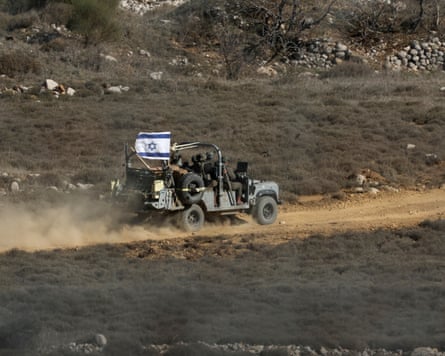
The bullets announced the arrival of the Israeli military into the remote southern Syrian province of Quneitra on 9 December 2024. In the place of Assad militias who used to patrol the roads, bulky armoured personnel carriers filled with Israeli soldiers rumbled down the potholed streets, stopping to assure residents that they were there for their protection.
“When the Assad regime fell, we didn’t even get to celebrate – it fell over there while they entered from here,” said 52-year-old Ibrahim, working at a falafel shop in al-Qahtaniya, close to the Israeli border.
The hard-fought freedom that reigns in the rest of Syria after 14 years of war is nowhere to be found here.
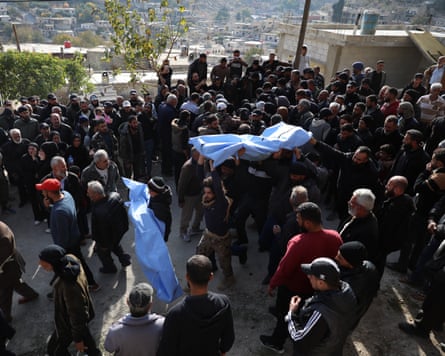
A year after Israeli forces entered southern Syria, crossing into a UN buffer zone and in some cases beyond, its occupation remains and the frequency of the Israeli military raids on towns is increasing. An Israeli incursion in the town of Beit Jinn at the end of November left at least 13 Syrians dead, including two children.
Residents say they have traded the tyranny of Assad for a military occupation. Checkpoints are now operated by Israelis, not Assad officers. Night-time raids and phone searches continue.
Israel says it sent troops to southern Syria as the Assad regime fell to protect the security of its borders, and that it will not allow the new Syrian government to deploy its forces there. Syria’s new authorities are in little position to resist. Israeli airstrikes and raids result in complaints at the UN security council in New York and little else.
Israeli soldiers have confiscated all weapons in the area, at first demanding people hand them in, and then raiding homes to search for hidden arms. Arrests of anyone suspected of affiliation with Iranian militias or Hezbollah are frequent. Interrogation usually lasts only a few hours, but some families say their male family members have been detained for months, their whereabouts unknown.
Ibrahim was one of the first to suffer under the Israeli occupation. His house, along with 14 others, was bulldozed to make way for an Israeli military base – one of six built across southern Syria over the last year.
“I asked them: ‘Why did you destroy the houses? We never lifted a stone against you, we welcomed you thinking you were coming as a protection force in peace,’” Ibrahim said. “The soldier told me, ‘Bashar al-Assad destroyed all of Syria. You’re upset that we destroyed a few houses?’”
“I told him, ‘When Bashar al-Assad destroyed things, it was during war. But you entered claiming peace,” he said. He paused each time a car drove by, wary of an Israeli military patrol seeing him talking to reporters. His 13-year-old son chimed in, puffing up his chest to say he was not scared of the Israelis, but he struggled to get the words out through a stammer that his father said he developed after Israeli forces entered their town.
Syria’s government has made multiple appeals to the international community to curb the Israeli occupation, a violation of a 1974 UN security council resolution establishing the buffer zone between Syrian forces and the Israeli-occupied Golan Heights.
The new government in Damascus is well aware that its newly formed army would stand little chance against the US-equipped Israeli military. Hundreds of Israeli airstrikes in the first days after the fall of the Assad regime destroyed almost the entire Syrian air force and much of its arms depots.
Syria has engaged in direct negotiations with Israel under US mediation, seeking a non-aggression pact and for a withdrawal of Israeli forces in accordance with the 1974 agreement. Negotiations have borne little fruit so far.
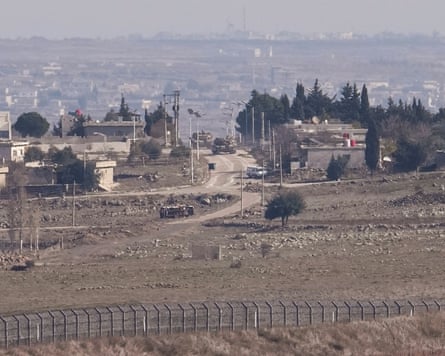
The Syrian government has little presence in the Israeli-occupied area, and it is Israeli soldiers, not the Syrian state, that rules over the area’s people.
If municipal services are required – such as electricity or water repairs – Israelis must be informed 24 hours in advance to allow the entry of trucks. Residents must also receive a permit from Israel before hosting a wedding or other gatherings, and people say drones often accompany them as they plough their fields.
Israeli soldiers have meanwhile conducted a survey to find out people’s needs in the area and have gone door to door handing out boxes of aid, sorely needed after years of war and economic sanctions.
Israeli military officers appointed Yassin al-Hamad, a 57-year-old local official, to coordinate his town’s affairs with them. He recounted how Israeli forces admonished him after a truck came to the town to repair electric poles without his knowledge.
“If something happens – even a small thing – a vehicle comes to your house. Any issue becomes something. You can’t leave the house freely,” Hamad said. He added that he and others had started to learn some Hebrew phrases – good morning, how are you? – to greet Israeli soldiers at checkpoints.
Israeli officers have told residents their presence is solely meant to prevent armed groups from operating on the border, but increasing military activity has left them wondering how long life under occupation will continue.
People are wary of returning to Quneitra, unsure if Israel will allow them to stay. Roads are cut off by mounds of dirt heaped by Israeli bulldozers and fresh tank prints line the streets. The fury of construction that has consumed the rest of Syria as the country tries to move on from more than a decade of war has not arrived.
Instead, it is only Israeli bulldozers that dig, steadily re-enforcing their new military bases.
“If I had even just a room in Damascus, I wouldn’t stay here for another minute. We’re living in terror,” said Ibrahim.