.png) 2 months ago
58
2 months ago
58
The leader of a Israeli-backed militia in Gaza has been killed, dealing a major blow to Israel’s efforts to build up its own Palestinian proxies to confront Hamas.
Yasser abu Shabab, a Bedouin tribal leader based in the Israeli-held zone of the devastated territory, is thought to have died from wounds sustained in a violent clash with powerful and well-armed local families, according to local media and sources in Gaza.
Abu Shabab was the commander of the Popular Forces, the biggest and best-armed of several militia that emerged in Gaza during the later stages of the two-year conflict. All appear to have benefited from Israeli support as part of a strategy of arming proxies to degrade Hamas and control the population.
The exact timing of Abu Shabab’s death is unknown, but it appears to have been in the last 48 hours.
Sources in Gaza and reports on social media and in Israel suggest that Abu Shabab, who was in his 30s and had been expelled by his own clan, died in a clash after refusing to release a hostage taken by his men from a powerful and heavily armed local family.
Relatives of the hostage mounted an attack on the Popular Forces base which led to casualties on both sides. Abu Shabab was reportedly badly injured and died of his wounds in Gaza.
A spokesperson for Hamas, which had called Abu Shabab a collaborator and promised to hunt him down, denied any involvement in the killing.
The Israeli prime minister, Benjamin Netanyahu, acknowledged in June that Israel had armed anti-Hamas clans and factions in Gaza but there has been no official comment from his government on Abu Shabab’s death.
Israel’s policy has drawn criticism from some experts who have said such groups can provide no real alternative to Hamas, which has controlled Gaza since 2007.
“The writing was on the wall. Whether he was killed by Hamas or in some clan infighting, it was obvious that it would end this way,” said Dr Michael Milshtein, a former Israeli military intelligence officer and expert on Hamas at the Moshe Dayan Center at Tel Aviv University.
Several other anti-Hamas groups have emerged in areas of Gaza held by Israel. The Palestinian political analyst Dr Reham Owda said Abu Shabab’s death would fuel doubts among them about their ability to challenge Hamas.
Hossam al-Astal, the leader of another newly formed militia operating in the area of Khan Younis, said in September that he and Abu Shabab offered “an alternative force to Hamas”. Astal’s whereabouts is unknown.
Abu Shabab’s hundred or so fighters continued to operate from areas of Gaza controlled by Israeli forces after a US-backed ceasefire between Hamas and Israel was agreed in October.
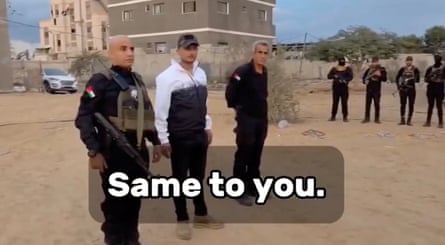
On 18 November, Abu Shabab’s group posted a video showing dozens of fighters receiving orders from his deputy to launch a security sweep to “clear Rafah of terror”, an apparent reference to Hamas fighters believed to be trapped in tunnels there. A week later, the Popular Forces claimed to have captured Hamas members.
Israel’s internal and military intelligence services turned to individuals such as Abu Shabab when it became clear that their efforts to build an anti-Hamas coalition of community leaders and family elders would not succeed in the face of fierce Hamas repression of any threat among Palestinians in Gaza.
Many of those recruited into the new factions had been engaged in systematic looting of aid convoys, leading to allegations that Israel was allowing some theft of humanitarian assistance to bolster its new allies.
In June, Abu Shabab – a member of the Tarabin Bedouin tribe – told the Guardian his activities were “humanitarian”, adding that he did not work “directly” with the Israeli military.
The Israeli strategy of backing militia factions such as the Popular Forces was one consequence of Netanyahu’s refusal to allow the Palestinian Authority, which exercises partial control over parts of the Israel-occupied West Bank, to administer Gaza in any way. Abu Shabab’s Popular Forces coordinated closely with Israeli forces around controversial aid distribution sites run by the Gaza Humanitarian Foundation, an opaque US- and Israel-backed private organisation that has now been shut down.
Donald Trump’s 20-point Gaza plan foresees Hamas disarming and the territory run by a transitional authority supported by a multinational stabilisation force. But progress has been slow, with Hamas so far refusing to disarm and no sign of agreement on the formation of the international force.
The war in Gaza was triggered by a Hamas raid into Israel in 2023 that killed 1,200 people, mostly civilians, and led to the abduction of 250. The ensuing Israeli offensive and strikes since the ceasefire have killed more than 70,000 Palestinians, mostly civilians, and left the territory in ruins.