.png) 2 months ago
57
2 months ago
57
Anthems over, Zak Crawley left the field and took the water handed to him by Matt Potts. If he was a little dry of mouth it would hardly be a surprise – even without the burden of the brace of ducks he took from the first Test, the situation he was about to walk into might have verged awkwardly close to terrifying. He downed half the bottle, donned his helmet and turned back around.
Mitchell Starc, the bowler who dismissed him in the opening over of each innings in Perth and is even more effective in these day-night games, dried his hands on the sun-baked turf as Crawley made his way to the middle, and picked up the new pink ball.
Three slips set themselves for some catching practice. Crawley left the first – pitched short, bouncing high – was non-critically bemused by a couple of wobble-seamers, and then punched his fourth through the covers for four, his first runs of the series. There are fewer English flags here than there had been in Perth, but what the travelling fans lacked in signage they made up for in gutteral, relieved, desperate roars. A single off the next brought some relief, for him at least.
It is hard to argue that England’s opening partnership was good exactly, for all that it was undoubtedly their best of the series so far – a low bar to clear, the challenge involving the accumulation of anything more than no runs. But there are few opportunities less inviting than starting the innings against Australia in a day-night game: of the 29 such partnerships from touring teams this was only the 10th worst and the sixth shortest, and it did not last as long as the opening over. Just seven of those 29 partnerships contributed as many as 20 runs, the same number scored fewer than three, and most didn’t make it to 10. Here Crawley had five before his partner faced a ball, but Ben Duckett didn’t get to face two.
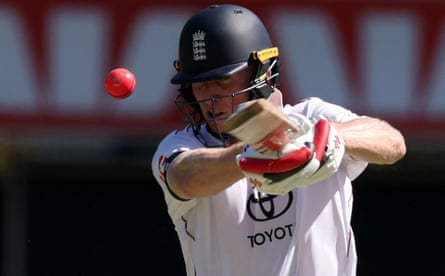
At which point many seasoned observers of English travails on Ashes tours would have been bracing themselves for a familiar and depressing few hours. But there had been a lot of talk in the extended gap between the first two Tests about England reflecting on where they had gone wrong in Perth, and it was clear here that some of them had. Ollie Pope, who as in the second innings of the first Test hung out an angled bat and lost his wicket to a ball he should have left alone, in Starc’s second over and with the score still on five, not so much. If Crawley shone here, it was only because he was one of the reflectors.
Though even then, he had his moments. Crawley had motored to 15 off 16 balls before Michael Neser sent down a delivery that whistled past his bat and nestled in the gloves of the wicketkeeper. The bowler thought there had been contact and may have been right, but this was one of the vanishingly rare occasions when the vague aroma of a wicket fills the air and Steve Smith, Australia’s bloodhound captain, fails to detect the scent.
There was also a near re-enactment of his second dismissal in Perth, but if then Starc had dived to his left to take an outstanding return catch, this time his follow-through sent him stumbling to his right, the ball was more cleanly struck, and after a fraction of a second of potential panic Crawley was able to admire its passage to the boundary.
There were seven more across the opening session, most handsome drives straight or through cover – and Crawley’s handsome drives are very handsome indeed. Perhaps as the interval approached Crawley’s reflection took him back a little further than Perth a fortnight ago, to the start of the first Test of the last Ashes series. Then he made an excellent start but fell just before lunch, and while in both innings he walked off after a couple of hours’ sterling work having scored precisely 61, this time he was unbeaten.
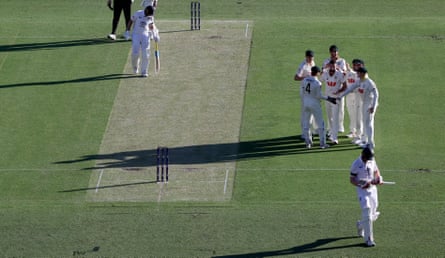
He started the second session explosively, with two more of those impeccable drives, off Brendan Doggett. In the next over Alex Carey came up to the stumps, trying to curtail the comfort with which Crawley was advancing to Doggett and Michael Neser. The immediate reward was another straight drive for four but Carey stayed up, breathing down the batters’ necks, cramping their style. The breakthrough came when he dropped back: the next ball was short, Crawley, off the leash, went for the pull and got a slight bottom edge. For the newly distanced Carey it was an easy catch. Crawley had scored 76.
He left the field, eyes on the ground and head shaking. He certainly did not see, and may not even have heard, those standing to applaud. Here was the player England have been willing to persevere with and wait for. Now he has more reflecting to do.